top of page

How to Polish Amber

How to polish amber by hand


Raw amber can easily be polished by hand. All you need is the right sandpaper, some water, some toothpaste, and a cloth. It really is that easy!


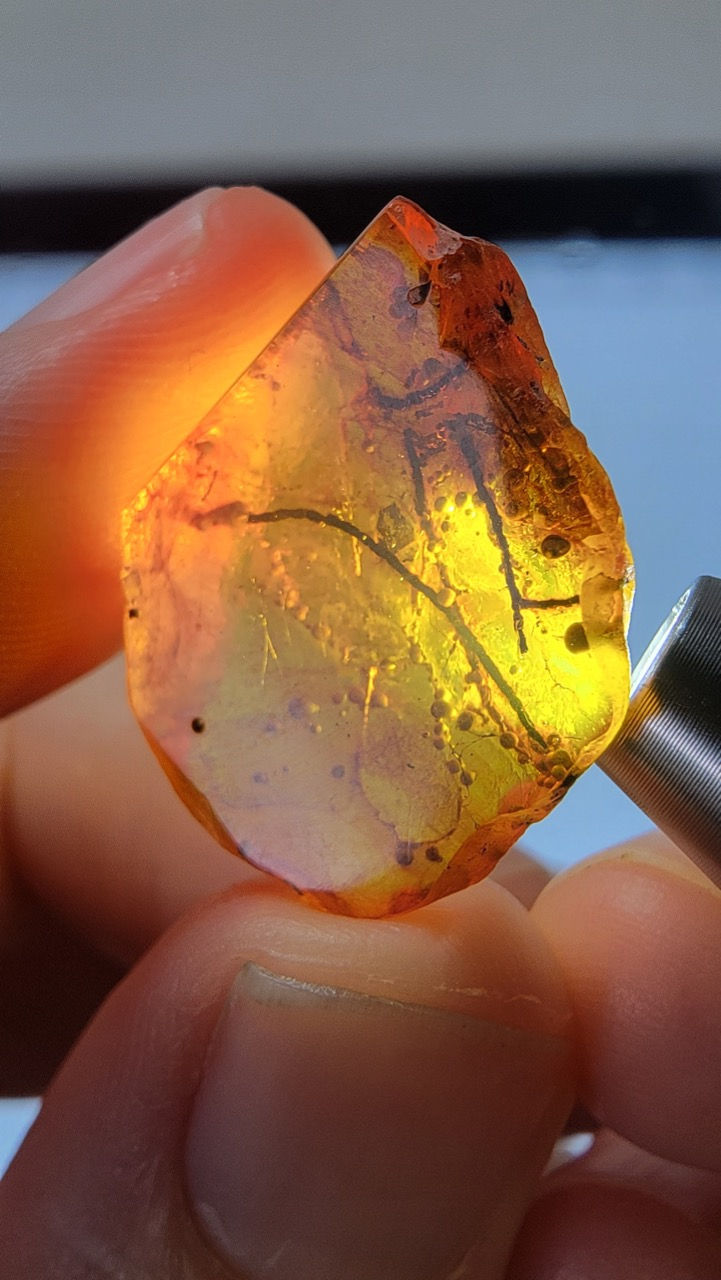
This post will teach you how to turn this:

Raw Burmese Amber - Looks like those long black lines inside may be plant inclusions. We must polish the amber to see what's inside.

into this!

Polished Burmese Amber - Revealing what we suspected: An anther inside! The male part of a the flower that produces pollen. This is a rare find.

Materials You Will Need:

  • Sheet of waterproof sandpaper grits 80, 120, 220, 400, 600, 800, 1200, 2000. Or any combination of similar grits that starts with 80 and ends above 1,200. 

  • A tupperware of water that you can rinse and refill.

  • Toothpaste

  • A cloth, or jeans.


To polish the raw amber, You'll want a sheet of waterproof sandpaper grits 80, 120, 220, 400, 600, 800, 1200, 2000. Or any combination of similar grits that starts with 80 and ends above 1,200. 

Amber Polishing Materials - Sandpaper grits 80 through 2,000. A bowl of water. Some jeans, cheap toothpaste, and of course, raw amber.

Have some water in a tupperware on the table, and maybe a towel to keep it clean because it can get a little messy.


Step-by-Step Polishing Process. Let's Find Some Inclusions!


To begin, get the 80 grit sandpaper ready and your water. The 80 grit is the roughest grit. It sands off the rough skin, gives it the shape you want. Today we will polish one half of the amber, and leave the other half raw. This is called a "window" into the amber. It is all you need to search inside for insects in amber.


Start by dipping the sandpaper and the amber in the water, getting them thoroughly wet. Place the sandpaper flat on the table. Now take your amber and rub it strongly on the sandpaper for a moment. You will see a foam develop, and the amber begins to take shape.


Polishing Amber by Hand With 80 Grit Sandpaper - Rubbing the raw amber vigorously on wet sandpaper will start to grind away the edges, and give it the shape you choose. Clean the amber and sandpaper in water frequently, and replace the water frequently to eliminate rocks that will scratch the amber more deeply than the sandpaper.

Loose pebbles from the skin come loose into this foam. They must be removed. You must wash the amber and sandpaper in the water to remove them. Wash them frequently every time they get dirty. And also remember to throw out the water every time it gets too dirty, and between every step. Loose pebbles in the foam can scratch the amber, ruining the polish. Do not throw this water down your drain! It could clog it.


Repeat sanding with the 80 grit sandpaper until you get the general shape you want. Then you will be ready to move onto the next grit, 120. Be sure to polish patiently, and take your time each step. That is how you get a great polish at the end.

The Results of 80 Grit Sandpaper on Amber - You see it has deep scratches. That is normal. These scratches will get finer and finer as you go up in grit, and eventually disappear, leaving a mirror finish. We have chosen to make a flat window on this side.

Now rinse out your water and get some fresh water. Put your 120 grit on the table. Now sand the amber with it, firmly, washing it when it gets too dirty. As you sand the amber, it eliminates the deep scratches from the previous 80 grit. You must sand for long enough to eliminate the deep scratches from the previous grit, otherwise the deep scratches will remain and ruin the polish. Here are the results. Compare with the previous picture.

Results of 120 Grit Sandpaper on Amber - It is beggining to be very flat.

From here on out, you simply repeat the process for every grit of sandpaper. After you finish with the 120 grit, use your 240 grit. Rinse out the water every step. You will see the window you are polishing begin to become flat.
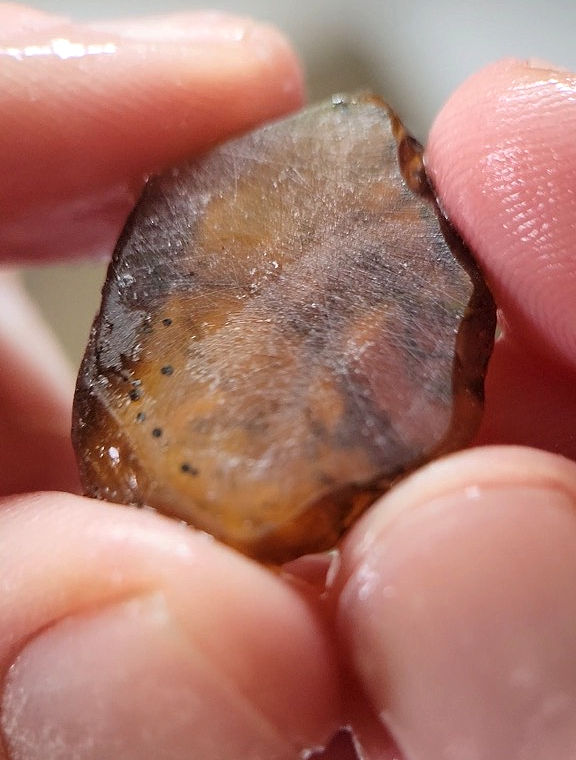

Results of 220 Grit Sandpaper on Amber - The amber is beginning to have a flat window. We can start to get a glimpse inside the amber.

Now repeat the process with the 320 sandpaper.

Results of 320 Grit Sandpaper on Amber - A flat face, and lots of fine scratches.

Now repeat the process of the 400 sandpaper:

Results of 400 Grit Sandpaper on Amber - The scratches are becoming finer.

When you finish the 400 grit, examine the amber for insect inclusions. This is the point at which you can start to see inclusions more clearly. That is why 400 grit is sometimes called "The jump grit," because it reveals what's inside. Insects will usually look like black shapes, and if you look closely you will see legs, wings, or antenna. There can also be plants and animals in amber, but more rarely. Inclusions are very valuable. Large, clear insects are the best ones to find.


Now repeat the process with the 600 grit sandpaper.

Results of 600 Grit Sandpaper on Amber - we can begin to see the shapes inside. We see something long with a bublous tip, which may be a part of a flower.

Now we repeat the process with the 1,000 grit sandpaper.

Results of 1000 Grit Sandpaper on Amber - Shown wet. It is beginning to be very clear

Now repeat the process with the 1,500 grit sandpaper.

Results of 1500 Grit Sandpaper on Amber - Shown wet. A clear polish is showing the interior of the amber.

The final sandpaper is 2,000 grit.

Results of 2,000 grit sandpaper on amber - now we can see clearly inside. There is a botanical inclusion, an anther.

Once you've gotten to grit 2000, you're done with the sandpaper.

Now it is time for the toothpaste and jeans step. Remember to use a regular toothpaste here, the cheaper the better. Crest works. But don't use the fancy stuff. This is because cheap toothpastes contain talc, which is a polishing agent. (Fun fact: you are polishing your teeth every time you brush them)

Polishing the amber with cheap toothpaste and Jeans - Putting toothpaste and water on the jeans, you rub the amber in the paste for a while. Take your time on this step.

After you finish with the toothpaste, wash and dry the piece well. Then you will reveal quite a nicely polished piece of amber.

Results of Polishing amber with jeans and toothpaste - A very clear piece of amber!

It will look quite nice at this point. The final step is to apply a protective agent on it. The most common is car wax, because it does a great job. You can use oil, but it will rub off more easily. A great trick is to rub on car wax using styrofoam. That gives you a real mirror polish on amber.


We used car wax for our final protective layer - It is a common practice, and works great to preserve the polish and protect the piece

We used this car wax. The kind that we all have lying around our garage, and never use. Any brand will do. You can rub it on with a soft cloth, but we use our styrofoam trick.

Applying the car wax using styrofoam - an old trick that works very well. This is common among amber polishers. A cloth will work well too.

Give it some time with this step, then clean it off with a cloth. Wipe away all the excess wax. Look at the Mirror finish we are left with:
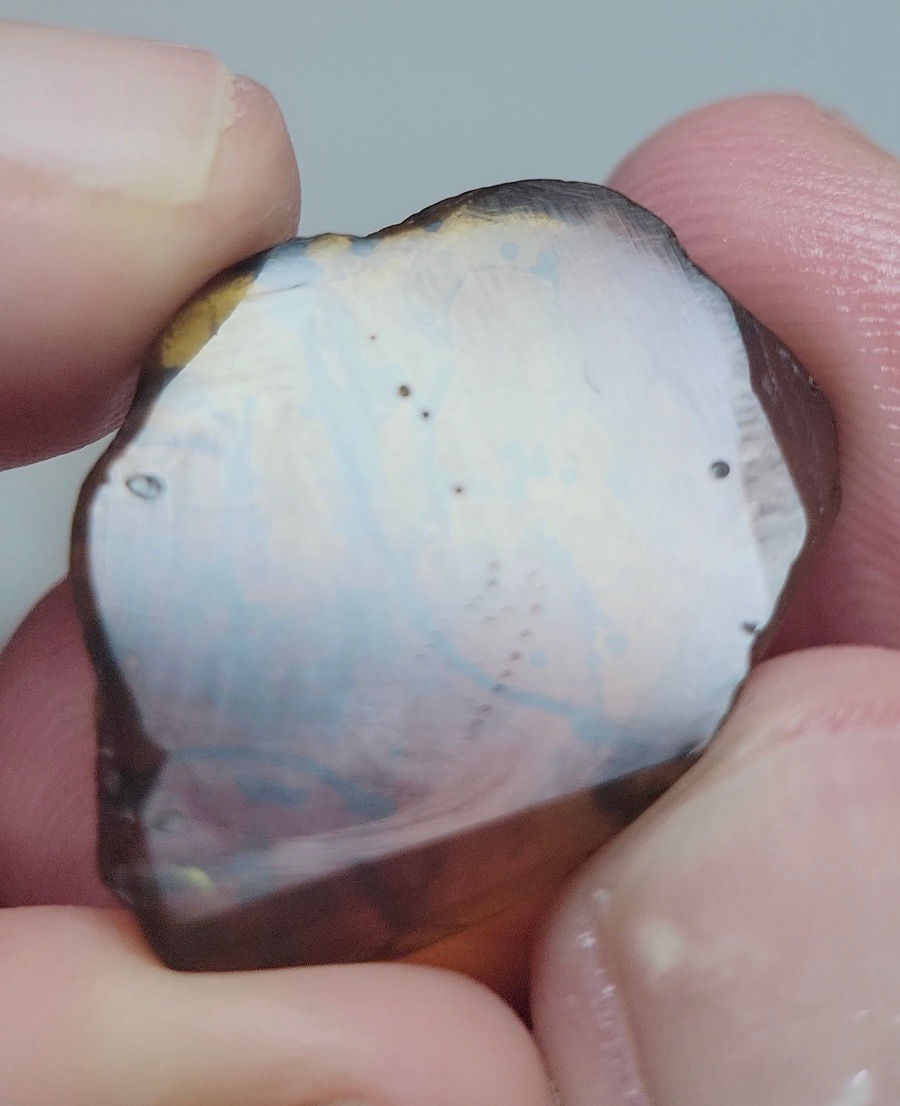
Results of applying car wax with styrofoam - A mirror finish!

The amber after the final polish - A clear window showing the amber in all it's splendor. We see a clear botanical inclusion. An anther, the male part of the flower, that produces pollen.

Now you are finished polishing your amber. Hopefully, you find some interesting inclusions or colors! Remember that colors of amber mean different things, and can be rare just like inclusions. For example finding blue in dominican amber means that that amber has smoke / burnt wood inclusions!


A 60x microscope, a loupe, or a magnifying glass will help you search better for insects. Some are too small to be seen with the naked eye.


1 Comment


hpsfrogger
4 days ago

Ryan your polishing instructions are put together very well. This will turn newbies on to polishing their own pieces.

Like
bottom of page