How To Tell Real Amber From Fake Amber
- Ryan Zschomler
- 2 days ago
- 21 min read
Updated: 7 hours ago
Today we’re going to go over how to tell the difference between real amber and fake amber.

Now, there’s a lot of fake amber out there, but just to clear this up, there’s only two kinds of fake amber that you really need to worry about, in terms of getting scammed and buying stuff online. Type number one is fake insects in amber. And then the second type is fake amber jewelry. Those are the two main things you need to worry about.
So the first section of this is blog going to be insects and amber. As you see, we have a spread in front of us, and this is a mix of real versus fake insects and amber. Some of them are real. Some of them are fake. First of all, can you tell the difference just by looking at them? An expert eye can tell the difference. So let’s break it down.
Let’s go over it piece by piece.
Fake amber #1: Fake insects in Amber
Okay, first of all, Fake insects in amber are made with plastic. think about the phrase, "if it’s too good to be true, it probably is. "Any insects you see on the table that are really big and really perfect are probably fake plastic amber because amber has a size bias, meaning it likes to capture small insects. In fake plastic insects in amber, they always use very large insects with perfect clarity. Real amber doesn't function like this. Real amber has mostly small insects, and lots of color and character. Big clear insects (like the ones in fake amber) are exceedingly rare and fetch a high price on the market.
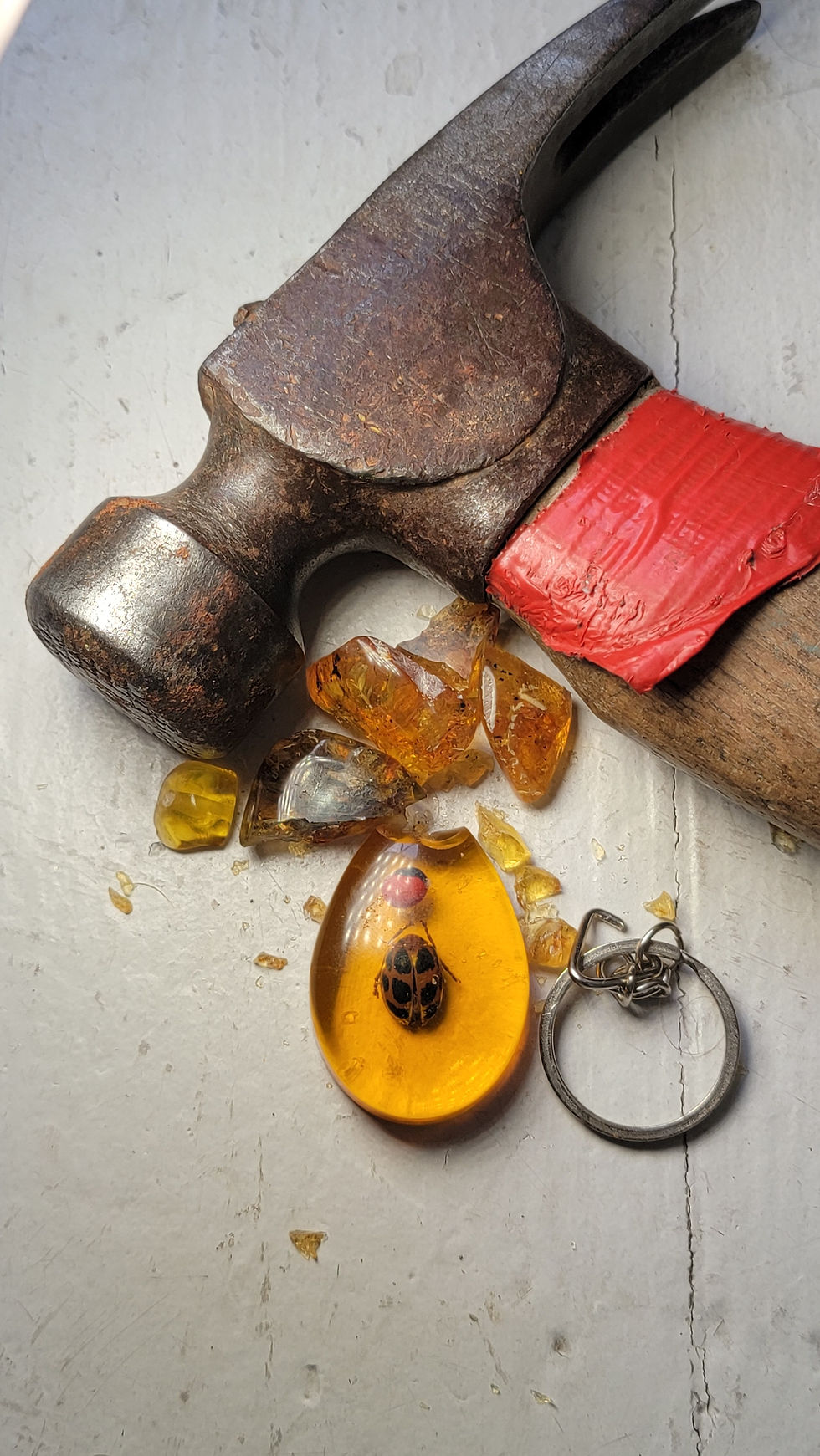
So the first and probably the most obvious one is this one in a package. This is a very big, clear beetle. It’s on a key chain, which is a red flag. The beetle’s too big, too perfect. Any real insect in amber this size in amber would be museum-grade, worth $1,000 or more. But you can buy these fake ambers online for $5 apiece. These fake ambers are made via an injection mold. So they have a mold. They have a dead insect, and they inject the plastic into it, and then it comes out perfectly shaped with a little hole in it already, and they can just put the key ring through it.
ADD PHOTO OF AMAZON.COM SCREENSHOT BUYING FAKING AMBER
The second thing is also it comes in a mass-manufactured package, which is a red flag. And these packages, they almost always have some vague phrase about natural amber without ever saying this is real amber. They’ll beat around the bush. So this is a good example of that.
Third of all, you might see that these come in a pack. So you can buy identically shaped, identically colored pieces, and they’re all key chains. That should be another big red flag that it’s fake amber because real amber never comes like that.
Below are images of mass produced fake amber keychains.


The second thing is also it comes in a mass-manufactured package, which is a red flag. And these packages, they almost always have some vague phrase about natural amber without ever saying this is real amber. They’ll beat around the bush. So this is a good example of that. Third of all, you might see that these come in a pack. So you can buy identically shaped, identically colored pieces, and they’re all key chains. That should be another big red flag that it’s fake amber because real amber never comes like that.
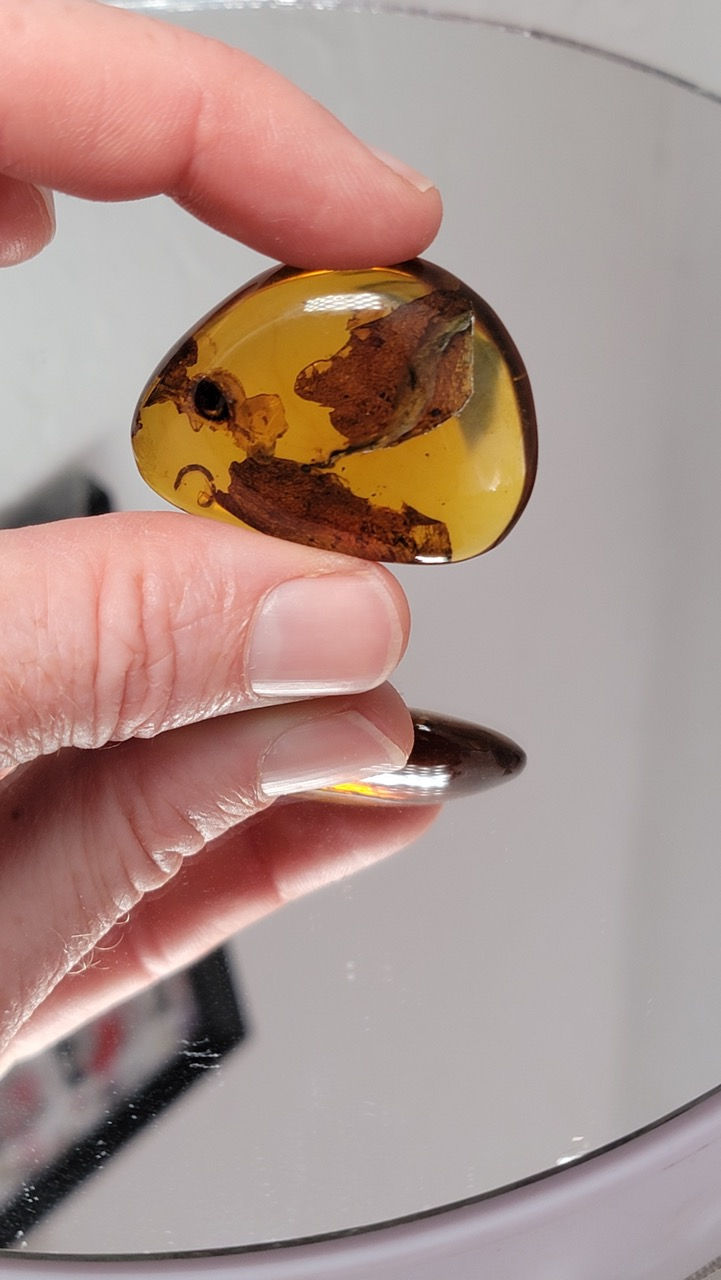
Now take a look at this real insect in amber from Burma. You’ll see that the shape is irregular, and it has a raw side. And the insect inside is a lot smaller, not perfectly clear, and it’s also in a little – this one’s in a pretty good position, but they’re not always in such good positions. These are all qualities you want in your real insects in amber
This piece right here, this is Burmese amber from the time of the dinosaurs. Also, you see this little raw part here where it’s not polished? The polish catches the light really well here, but right here it’s not polished at all. That’s because it was the skin of the raw amber, which is another really good sign. If you see that, it’s a good sign it's real.
Authenticity test #2: 365nm UV light
Okay, so now check this out. Check this out. If we turn off the lights here and we hit it with a UV flashlight, which is one of our main ways to test real versus fake amber, real amber will glow under the flashlight. But fake amber doesn’t glow under the flashlight. But you’ll see that it does have a little bit of a reaction.
So this test is good, but it’s not perfect because real amber and fake plastic amber can have similar but different glows. Amber glows much more strongly to UV light and also reveals hidden characteristics with it, which plastic does not. it can be hard to tell the difference of the glows sometimes to those unfamiliar. And although it’s not perfect, but, you know, it’s just the way it is. you can see that there’s some caveats to this.
What you do want to see when you hit amber with a UV light, you want to see it bring out characteristics. So this is a little slab of Mexican amber. And as you can see, this slab has flow lines. These characteristics are revealed by the UV light. Look at the before and after pictures below.
So real amber shows different things under the UV light. The UV light is test is pretty good.
When I’m hitting all this with a UV light, you see most of them have pretty good reactions. The fake ones don’t. But it’s not super definitive. So you’ve got to have a good eye for the UV light for this stuff.

Let’s get into this one next. This one, this piece right here, it’s not exactly fake amber, but it’s close to it. This is a scorpion in a lollipop. And so what they did was they made a sugary lollipop and they poured it over a real scorpion here.
So they encased a real insect in resin, which is – it’s a sugary resin, but plastic is a resin too, and amber is a resin too. So it’s a similar process.
And another thing about the UV light that’s very interesting is scorpions, as you know, are UV reactive. When you hit a scorpion with a UV light like this, it reacts. It glows. So every time they put a scorpion in fake amber, it will glow. But a scorpion in real amber will not glow under the UV light. Real scorpions in real amber lose their glow.
Authenticity test 3: Imperfections in Amber vs. Perfect Plastic Fakes
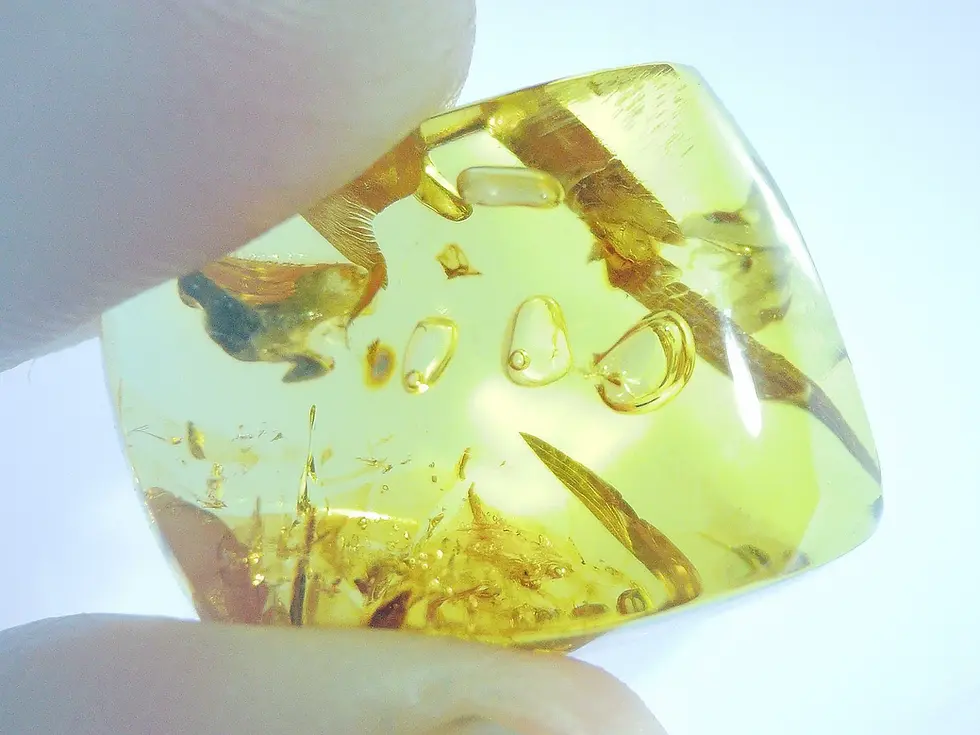
Okay, so now another thing that we’re going to want to watch out for or look out for is like basically imperfections in amber. Imperfections in amber are desirable because all real amber has imperfections.

Let’s look at this piece for example. Now, this piece here, this is a mosquito and a cockroach, and as you can see, it’s not perfect. There are some colors. There’s some bleeding to it. There’s like all these little differences, but it’s a pretty – it’s a really good piece of amber, but it’s not perfect, and that’s very important. Let’s check out another one.
For example, this one here. This one is a mosquito in amber, and as you can see, there’s two big cracks running down the piece, and there’s a bunch of bubbles coming up through the piece. And all these different imperfections really lend towards the fact that it is real amber.
Oh, and you might also find a lot of small little bugs. You might see that small bug right there. You can find small unexpected bugs in amber. That’s a thing. In fact some of the rarest and coveted bugs in amber can be very small, like pseudoscorpions.


Authenticity test #4: Understanding Raw amber
I want to show you guys raw amber.This is something that just so you can understand where amber comes from. Raw amber is like a rock, how it comes out of the ground, but it’s not a rock. It’s a fossilized tree resin.
Raw amber looks like a rock, but it is translucent when you put a light up to it period regular rocks are not translucent. If you hit it with a flashlight, it is translucent. So this was mined out of the ground in Burma, and as you see, when you put a flashlight to it, it becomes very clear. So this clear thing with the flashlight, that’s obviously amber, but it looks like other rocks.

And here are some other rocks I picked up on the ground. This is a regular rock, and as you can see, it’s not translucent. And fake amber can come in small or big sizes, but this one’s amber. This one’s not because it’s not translucent. Not amber. Amber.
Take a look at a few more pieces of real amber side by side with fake amber, just so you can see the difference. The ones I’m showing you are very museum-grade, but as you can see, they all have their imperfections.
In each of the photos below, the real amber piece is on the left and the fake amber is on the right.
Authenticity Test #4: The Rub & Smell Test
The next way that you can tell is that if you take a piece of amber and you rub it very vigorously with your thumb until it gets warm and then you smell it, it will smell very rich like amber. If it is fake amber, it will not have a pleasant aroma.
So you do that and then you smell it and it smells – oh, it smells very good because the amber is the fossilized tree resin and it has a really good scent to it.
Whereas if you do the same thing to plastic and you rub plastic vigorously until it gets warm and then you smell it, it does not have a pleasant smell. It just smells like plastic, which is not the greatest thing. That’s another very good way.
Authenticity Test #5: Know your dealer
Okay, so if you’re shopping for amber online, first of all, amazon.com has no real amber. Amazon.com is a bad place to buy amber. Ebay.com has good amber, so you can do that. But avoid Amazon at all costs.
And look at the prices of things. If you see a giant insect for merely $5 or a set of giant perfect insects that are perfectly clear and they’re $5 each, run. That is not a real insect in amber.

Another important factor is the shape. Fake amber is almost always some very plain, simple, repeatable shape, and real amber comes in all sorts of different shapes. This is because of the fact that the raw amber has its original shape, and they have to shape it accordingly.
So as you can see, this one is quite obviously clear and square, because amber is almost never going to be in a perfect cube or rectangle, like this spider. This spider is too perfect. This is a huge red flag.
Also, this is yellow-colored plastic, or this is white plastic, and the other ambers are in yellow-colored plastic, but amber is usually naturally yellow.
As you see, almost none of our amber pieces on the table are in a uniform shape in any way. They’re all different.
Our next section here is Fake Amber Jewelry. So, check this out. First of all, we have a couple of amber necklaces. All of these are finished necklaces. Can you tell which one is real? Can you tell which ones are fake? I will show you.
Our first test is a UV flashlight. So if you hit them with a UV light, the real ones will glow, and the fake ones won’t. So you see, this one doesn’t glow at all. This one lights up like a candle. So if I light up the board with a UV flashlight, you see the ones on the right lighting up, and the ones left not. Thats how you know the necklaces on the right are real amber and the necklaces on the left are fake amber.
That’s how you know this one’s fake and this one’s real. This is clear Baltic amber. This is clear yellow plastic.
Okay. Now, you might… Okay, this one as well. Look at this. Not really lighting up too good. This one is an interesting one. I can’t say much about it other than it’s a mixed amber and plastic thing from Indonesia. And you see it on the market sometimes, but it’s really not. It’s really not. Don’t get it. It’s not really that great unless you can get it really cheap and you like it.
THIS PARAGRAPH NEEDS PHOTOS FOR IT. WATCH VIDEO TO GET PHOTOS.
.

But still, this one right here, Dominican amber. This Dominican amber necklace is lighting up like a candle because it’s real. And you can tell that it’s got, like, mixed colors and stuff.
TAKE AND ADD PHOTO OF ALL REAL NECKLACES. PUT PHOTO HERE
Let’s break them down. Let’s take a deeper dive at each one of these. So let’s break these down.
First of all, this one right here. This plastic necklace, in theory, boy, does it look amazing. Boy, does it look like it could be a really AAA piece of amber. And it could. Like, there is AAA amber that looks like this. There is AAA amber that looks like this, but it’s not. But this is not.
And the thing is, if you look at it really close, you see no imperfections, no character, no nothing. It’s always every single bead is just totally perfect. It's too perfect. And we don’t like that in amber. Only the most triple, triple, triple diple AAA is this perfect. And that’s really hard to come by. And it’s pretty rare. You don’t see it that often, unless you are buying from specialty amber dealers.

Now, look at this one here. This is the Baltic amber mizbah. This is the most AAA clear amber we have. Compared to the plastic necklace, you see how these two are very similar. And very similar in color. The real baltic amber misbah here is valued in the mid $300 range, but the necklace would cost $5.
And once again, with the UV light, this one lights up like crazy. The other one doesn’t.
Okay. So now what happens is if we look at this AAA Baltic one a little closer, what we’re going to see is tons of character inside of the beads. Albeit very subtle, it’s going to be lots of character inside the beads.

So let’s start looking at the beads one by one. This is really AAA, so it’s almost hard to find. But I’m going to hit it with the UV light. There we go.
Now under the UV glow, you’ll see some of them will have flow lines. Boy, it’s looking pretty perfect. But there are a few flow lines..
Well, it’s really AAA. The UV test is going to be our main test for this one because this is super AAA. It was just cut from the clearest of the clearest.
Okay, now to a more average type of amber color with lots of character. Let’s show the Dominican mixed colors ones next to the fake plastic ones, and put them under a UV light, and you can see a big difference. With the Dominican ones, the Dominican ones obviously are glowing very well, and the fake plastic ones not so much. That’s another very, very clear sign right there.

So when they’re just together like this, you can tell by the fact that this one has mixed colors and a lot of unique stuff. In fact, this bead right here looks like it might have an interesting inclusion. We might have just found something surprisingly cool in our hands. Side quest, let’s check out that bead under a microscope. Ooh, interesting. Interesting. See what we found in the photos below. It looks like a spiderweb in an amber bead.
Approximately 75% of the amber in the world is this mixed colors from any deposit, from Mexican, Dominican, Burmese, Baltic. Just like these mixed color beads. And when it’s mixed color like this, you have a good chance of finding random things inside. Sometimes you actually can find insects inside. So these are very popular.

And then this Indonesian resin one, this one, you do see this in the marketplaces sometimes, and you do see it around. Just know that it’s not completely real amber. It's 50% real and 50% fake. I’m not exactly sure how they make it. I’ll probably update this post in the future with more information on that. But the point about this is that this stuff is not your best bet. But of course, beads are a thing of taste. If you like a certain bead, you can get it.
So with that, we’re gonna do a whole new board now. So moving this over, and now let’s look at some different colored amber and fake amber situations.

So right here, we have a mix of some new colored beads. Now, okay, first of all, in this screen, can you tell which one is the real amber and the fake amber? Let’s see.

We can do the UV test, which works pretty well for amber. But remember, it’s not definitive because not everything shines super well. So if I just kind of go like this over it, you’ll see these beads aren’t really reacting so much. These ones are doing good. These ones are Burmese amber, and these ones are, of course, real amber, even with some inclusions inside.
And this one is butterscotch or royal white amber, which glows pretty nicely under the UV light. And this one’s similar. This one’s similar. Another butterscotch white amber.
Now, can you spot the fake amber on the table? Let’s see. On the table, there are two pieces of fake amber, and this one would be one of them. This one looks a lot like the, this is almost the same color as butterscotch amber and butterscotch amber chips. And butterscotch amber can kind of look like this in the raw, just so you know. Sort of similar to that.
And let’s see if I like this more like that. The thing about these is, first of all, this, let’s put them under the UV light so we can see if there’s a difference in their UV reaction. Butterscotch amber does react to UV light, as you can see on the right, but it reacts a little differently than clear amber.
So this one is a stone. This one is actually a translucent stone, probably carnelian or something, but it’s a stone that just happens to be the same color as amber. But it’s not actually amber. The fake amber bracelet shines purple in the UV light, which is to say it doesnt react to UV light.

And two ways that you can tell, this is kind of off camera, but one, you can tell that this one’s a lot heavier. The one on the left is a lot heavier than the one on the right because amber is a lot, because amber is very lightweight. And second of all, the stone ones are very cold to the touch because stone and glass can be very cold to the touch. And so you can tell it’s not amber as soon as you touch it.
If you were to burn them, you would get different smells. This one wouldn’t burn because it’s a rock and amber would burn. And yeah, also when you see this chip formation, thats'. agood sign as long as its lightweight, lighter and warmer than rocks. So this is usually a good sign, but this is what you might encounter in a similar situation.
So there’s that. And also, interestingly enough, on this one, the tag, if you look closely, the tag said real amber, but then they scribbled it out and it was real amber. It was for 10 bucks and they scribbled it out and then they wrote $4.99 underneath because they realized it’s not real amber. So that was funny. I bought this at a store and the tag was already like that.
Next up on the list are these amber necklaces. So this is like a Burmese amber necklace and a Burmese amber necklace is quite nice. 24 inches.
This is a mixed fake mixed real amber necklace. So check out these two next to each other. Mixed fake and mixed real amber necklace. So let’s check out them both under the UV light, which is our our go-to test. So if I hit it with the UV light and I go back and forth, you’ll see they all, they all light up pretty good. So this one’s an interesting one.
So here we have, first of all, this Burmese one is awesome. I’m going to put it down. This fake amber, medium fake amber necklace is more than one we’re interested in.
The reason being, if we look at this necklace up close, we will see that the white amber chips of this necklace are real butterscotch amber, just like this. These are real butterscotch amber chips and the beads here, they also light up but they display strange characteristics.
Why is that? Because the beads are pressed or heated amber and the pressed or heated amber has this characteristic which is just kind of like a smoky and melty, a little bit hard to describe, but I suppose you can see it on the camera. And it loses Uv reactivity when it undergoes that process. So it doesnt shine a teal/green, it reflects a dull purple.
So yeah, this one’s interesting because it’s mostly real amber. Basically, it’s just with these pressed amber beads. So it might throw you for a loop.
Okay, so also there’s royal white amber. This is a good color and it’s usually not faked. But it is pressed, which we will cover later in this article. It may be imitated (like the stone bracelet above that was labeled as amber). Raw amber of this color might look something like this.

If you’re shopping for amber and you see this spread of different colors, including butterscotch, white, darker, mixed colors, that’s what you want to see when shopping for real amber. You want to see these mixed colors. Because there’s a lot of different color options available for each deposit. And this is all Baltic amber, when we’re talking about the Baltic amber deposit.

You know, they have clear amber, dark amber, butterscotch, and royal white like this are some of their more favored ones. And then, so yeah, so if you’re shopping and their options look something like this, that’s probably a good place. This is a very classic color, those mixed colors there. Those are very classic. So those are all good signs.
Next up is silver amber jewelry.
So you can put amber in silver, you can put plastic in silver, or you can put heat-treated pressed amber in silver. And they’re all different kinds. So let’s see.
First of all, the most important thing of this whole section to show you fake amber is to show you what is basically the most common fake amber on the market. And that is heat-treated Baltic amber.
So you look at this ring. I’m sure every jewelry aficionado that’s ever gone shopping for amber has seen a ring with these kind of characteristics in a jewelry store. There’s all these little reflective things inside of it. Those are called spangles. Those are actually from heat treatment.
This is a heat-treated Baltic amber ring, and they put it through a process that makes the amber stronger, supposedly, but it also makes it clearer. And those little starburst things in there are called spangles.

Now, it’s really important that you know that this kind of amber, although it’s the most popular on the market, it’s slightly altered. It starts as natural raw amber. It really is mined out of the earth, but they put it through a machine to cook it in heat and pressure.
This is the most common thing that you see in all the jewelry stores, and you see a lot of necklaces with the same kind of things, too.
Here’s another one, a Baltic amber silver cross here. And this one, in fact, both of these have these kind of some of these heat-treated characteristics.

And so let’s check it out a little closer. This one has a bunch of small little amber cabochons.
So we’re going to hit these guys with the UV light and see what lights up. And so very important to keep an eye on this ring. So look at this one. This one lights up. This one lights up pretty good. These ones light up good. All these pretty much light up good except for this one heat-treated ring.
You can see the reaction. The color is very different. And I’m going to do a little close-up of, like, for example, two amber rings right next to each other. And you see the UV light reaction is very different for these two rings.

This ring right here that’s glowing a lot, that’s a ring from Burma with a mosquito in it. That’s a real amber ring with a mosquito. And this one here is the pressed or heat-treated Baltic one. And you can see their UV reactions are quite different.
The Burmese one being much stronger and the Baltic one being much weaker, because the baltic lost some UV reactivity due to heat treatment.
And you can see the UV light hits them very differently, each of them very differently.
So the heat-treated Baltic one here is – it loses some of its UV reactivity due to the heat treatment process. So it still is UV reactive, but it loses some of its reactivity, and it has those spangles, which I was explaining before. Those are a telltale sign it’s been heat-treated.
Now, this is Burmese amber. This is all real amber. You can see they’re glowing super well. And these have insects inside of them. And you can see that in these ones, they have insects, but the insects are very imperfect, which is actually a good sign. So that’s a very good sign right there.
This is very high-grade insect and amber jewelry. So compare that to the heat-treated one, and you can see a big – you can tell there’s a big difference in the quality of stuff. Look at that. Look at that. Big difference.

And here is another form of amber that is something you see a lot, where it’s an amber cabochon that’s painted black on the back, and then they do a reverse intaglio. It’s painted black on the back, and then they do a reverse intaglio.
And so it’s interesting, but this one is interesting. As you can see, the UV reaction is pretty good on this one. Not bad.
Last but not least, a very real, very museum-grade scorpion and amber pendant. And once again, when we use the UV light, one of the main things you always want to look for is special characteristics coming out of it when you hit it with the UV light.
You want to see some special characteristics that are like flow lines. Like see those lines that appear and disappear with the UV light right there? You see those lines? Those are called flow lines, and those are the layers that the amber was laid down in.
Flow lines are a surefire sign that it’s real, because no fake plastic amber ever has flow lines.
Fake amber #3: Pressed Amber & Heat Treated Amber
Last but not least, we’re going to go over the difference between natural Baltic amber and pressed Baltic amber. So keep in mind, Baltic amber is the only deposit in the world that does pressed amber.
Now just to show a few basic things, look, here’s normal, real, natural amber, not pressed or nothing, right here, right? Those are little children’s teething necklaces. Here’s normal, not pressed, not heat-treated Baltic amber, and they’re half-polished, but they’re mixed colors, children’s necklaces, pretty nice. PHOTO of amber in above paragraph
Next up, here is pressed Baltic amber, children’s necklaces. And these ones are pressed amber, and I’ll show you what raw pressed amber looks like. Let’s see here. Okay, so anyways, these ones are pressed amber. Look at these. These are pressed amber.
PHoto of amber in above paragraph
And now let me show you what raw amber looks like. Raw Baltic amber could be something like this. You can see it’s kind of yellow. Raw Baltic amber, it may look something like this. Let me get a better piece, actually. Raw Baltic amber may look something like this, whereas you have the raw amber and you put a flashlight up to it, you see it’s very clear.
Photo of raw baltic. inabove paragraph
So if you were to make beads out of this, you would get beads that look something like this, or like this, right? You get maybe some mixed color beads or some clear beads, but you get beads out of it that look like that.

Now, there’s other colors of Baltic amber, like this white butterscotch one, that this butterscotch raw amber, if you were to cut this thing up, you would get beads that look like, if you were to cut this up, you would get beads that look like this. Let’s see, here we go. If you were to cut this up, you’d get beads that look like this.
Let me, I’m going to do another example, like, you cut up clear or mixed, you cut up mixed colored amber like this, let’s do this one, you cut up mixed colored amber, you can get beads like this. And if you cut up like a very large triple A Baltic piece, very large triple A, you can get amber that looks, if you cut up a very large triple A piece like this, you can get beads that look like this, this would be like the corresponding beads.
So, last but not least, we have pressed amber. So this is a block of pressed amber, look at this, this is clearly man-made, but what it is, is they took, in their workshop, when they work with a piece like this, if they cut it and they get little scraps of this nice white valuable color, this nice white color, it’s called butterscotch or could be bone amber, it’s, they’ll get little chips that are too small to make something like this.

ADD PHOTO OF SMALL AMBER CHIPS
So if they’re really, really small chips, what they do is they collect them in a, they collect them and they put them in a autoclave, which is something that cooks it under high heat and high pressure, and in the autoclave, all those little pieces melt down and they melt them into a mold like this, they melt them into a mold like this.
And then they can take that mold, once it cools down and it’s ready to cut, this is real amber, it’s just been re-melted, and so it’s kind of recycled.
And then once they take that, once they cut that amber and they make beads out of it, you can get beads that look something like this. So these would be the kind of, this would be the kind of beads that you would get if you cut up this.
Or if you got a different color, like if you got a different color ingot, depending, the color will change depending on the types of scraps you collect, and you could get something like this.
So that’s it for how to tell real amber from fake amber.
Some other interesting Blogs


Comments