
Ancient insects trapped in amber discovered in South America for the first time

Cretaceous amber from Ecuador gives new insights into South America's ancient forests.
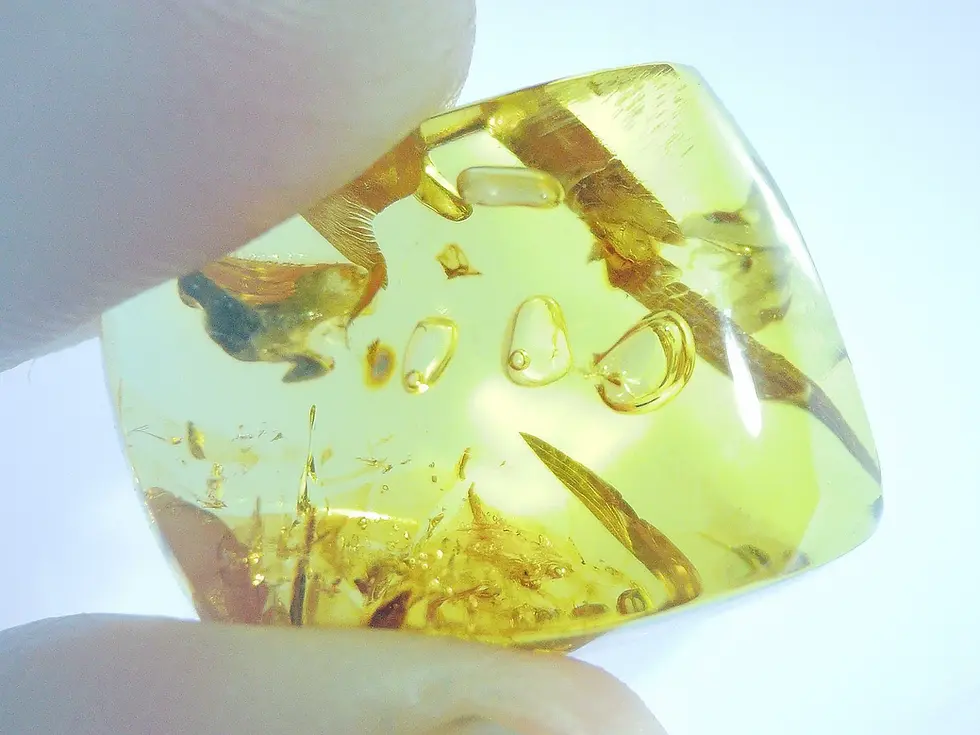
Sometimes small amber deposits can be found around the world. These small pieces of amber can contain insects from the time of the dinosaurs, or any time from the past. Such a deposit was found in Ecuador, with amber dating back to the cretaceous. A group of 21 different insects were found in this Ecuadorian quarry. This the first time insects in amber from the cretaceous have been found in South America. Note that Colombian copal is a similar material in south america, but it is not from the cretaceous. It is relatively modern.
At the time of this amber's creation, south america was a supercontinent called Godwana. The analysis of the material suggests the resin source is araucariacean trees. The same trees that made burmese amber, and still make copal today in New Zealand. It harkens back to a time when earth's forests were dominated by conifers that produced large amounts of resin, unlike today.
You can read the study here, which contains photos of the amber if you scroll down. The findings of the study were published in the journal Communications Earth & Environment.
The inclusions reveal that the continent had vast humid forests full of conifers, ferns, and invertebrate life. The lead author of the research was Professor Xavier Delcos. Finding these fossils was "an incredibly exciting moment," said Professor Delcos. "We never expected to find such a rich deposit, with thousands of amber pieces within a layer just 70 centimetres thick. Seeing so much amber in situ was truly thrilling, and it’s much richer than any other known Cretaceous amber deposit in the northern hemisphere."
“The amber from the Genoveva quarry in Ecuador has opened a small window into a time when global change was underway, from forests dominated by conifers to the tropical forests dominated by flowering plants that we know today.”
.

Where is amber found?
There are 5 main deposits of amber in the world, and then innumerable small ones. This ecuadorian deposit would be classified as one of the small ones. It seems to be rich, but not available is such large quantities as baltic amber
This amber dates back to a time in history known as the Cretaceous Resinous Interval, which is a time when earth's forests were much more resinous and sticky than today.
Cretaceous amber from this time is found in the northern hemisphere (Myanmar) but is generally not found in the southern hemisphere (Ecuador) until now.
“There are several reasons why amber with terrestrial bioinclusions hasn’t been found in South America until now,” Xavier explains. “On the one hand, it’s likely that the search for amber in this continent is not as advanced as in the northern hemisphere so it may be due to limited sampling.”
“Another possibility is that much of Gondwana was less humid, making it less likely that amber deposits would form. Finally, it’s also possible that the resin-producing trees of Cretaceous South America may have produced less resin than those in the northern hemisphere.”
This new finding presents that the amber in south america may actually be more abundant than previously thought.

What insecets were found in the South American amber?
60 samples of amber were studied. 21 inclusions were found within then, which is a good amount of inclusions for amber. Other deposits present less insect inclusions than that.
The most common species found were flies. This is a common finding amongst all insect-bearing ambers. One of the flies found could possibly be a new species of Microphorites fly, an extinct group only found in amber from other deposits.
Notable findings include part of a spider's web, parasites, parasitoid wasps, a springtail, a beetle, and. a caddisfly.
Plants were not found in the samples.
“Searching for new continental outcrops along the margins of ancient Gondwana, especially in more humid palaeoenvironments, should help to uncover previously unknown amber deposits,” Xavier said.
“This will give a better idea of how the region was changing as the two great southern continents, South America and Africa, began to drift apart. Studying the fauna and flora of these ancient ecosystems is essential for understanding the palaeobiogeography of many groups both living and dead.”
References:
Delclòs, X., Peñalver, E., Jaramillo, C., Cadena, E., Menor-Salván, C., Román, J. L., Castaño-Cardona, R. F., Peris, D., Carvalho, M., Quiroz-Cabascango, D., Carvalho, M. R., Blomenkemper, P., Herrera, F., Santamarina, P., Santer, M., Carrera, G., & Solórzano-Kraemer, M. M. (2025). Cretaceous amber of Ecuador unveils new insights into South America’s Gondwanan forests. Communications Earth & Environment, 6, 745. https://doi.org/10.1038/s43247-025-02625-2
Delclòs, X., Peñalver, E., Barrón, E., Peris, D., Grimaldi, D. A., Holz, M., Labandeira, C. C., Saupe, E. E., Scotese, C. R., Solórzano-Kraemer, M. M., Álvarez-Parra, S., Arillo, A., Azar, D., Cadena, E. A., Dal Corso, J., Kvaček, J., Monleón-Getino, A., Nel, A., Peyrot, D., Bueno-Cebollada, C. A., & Pérez-de la Fuente, R. (2023). Amber and the Cretaceous Resinous Interval. Earth-Science Reviews, 243, 104486. https://doi.org/10.1016/j.earscirev.2023.104486
Read more:



Comments