
Tardigrades in amber

Hunting for Tardigrades in Amber
by Adam Newirth
If you’re like me, you excitedly log into the Amberbugs live stream teeming with anticipation and excitement while another wrapped treasure is unveiled, prompting the chat to erupt with “tk.” Maybe you’re first, maybe you’re not, either way, the excitement is palpable. Every live stream feels like a treasure hunt. Will the next piece be a snail? Or a pseudoscorpion? Or maybe something even more rare!

Another wrapped treasure appears on the screen...

Hunting For Tardigrades in Amber
To me, this hobby is very much like a treasure hunt. I love the feeling of anticipation while I wait for Ryan to unveil the next piece. The possibility that it could be anything is genuinely exciting. That’s why I was also intrigued to write this blog about Tardigrades, a true “holy grail of amber!”
You read that correctly; these tiny microorganisms are the rarest inclusions known to amber collectors. Very few have been found. Before we get into why, let’s back it up a bit, and learn about what exactly ARE Tardigrades?
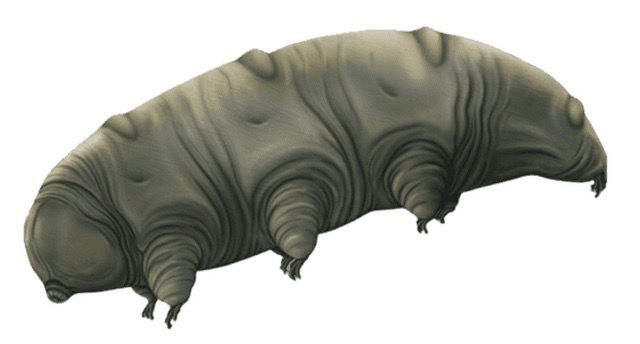
What are Tardigrades?
Tardigrades are resilient micro animals that have eight legs and a plump, segmented body. They are sort of squatty, fat little things, that are barrel-shaped, but somehow cute as heck! They have a circular mouth that dots a pudgy little face, and little claws on the ends of their legs. To add to their appeal, they lumber around slowly, mimicking the movements of their ursine namesakes.

They are known by a few nicknames, “Water Bear” and “Moss Piglets” among their more popular monikers. But what makes these microscopic creatures extremely interesting is their super-human strength.

Tardigrades are nearly indestructible. You can (try to) squish them, dehydrate them, freeze them, or irradiate them... and they’ll continue on their merry way, sometimes following a period of protective stasis called “tun.”

Where do Tardigrades live?
They thrive in the most extreme environments, have survived radiation in space, can go into a protective state when conditions are sub-optimal, and are generally all-around baddies. Tardigrades have been documented surviving for decades without water, which makes the prospect of finding one in amber interesting. Personally, I would love to know, can one have survived the fossilization process? But to find out, we would have to find one first and reanimate it. This process usually involves adding a drop of water to a dehydrated tardigrade, but this is for our modern samples. Fossilization may verywell be more than they can stand. But perhaps not...

How do we find tardigrades?
So where do we find these things? Here’s the good news: Tardigrades can be found everywhere! Its entirely possible that they are living very near to your current location. They thrive in damp and wet environments but can be found in all sorts of conditions.

Tardigrades in space!
These creatures are amazingly durable. Did you catch what I said before about space? Oh yeah, and not necessarily in the ilk of the “US sending dogs or monkeys up there in protective space suits.” Yes, they were intentionally shipped to low earth orbit, but they were also intentionally exposed directly to space... AND SURVIVED! Simply amazing.

Getting back to Water Bear hunting, if that’s your thing, search in wet areas, perhaps places where you find moss or lichens. What are lichens? (Wow, you have a lot of questions today!) Have you ever seen that cabbage-looking thing growing on trees and rocks while walking through the forest? Lichen.
There is a good chance that you can walk outside, find a damp rock with moss on it, or perhaps a leaf pile in your yard or the woods. Collect a sample from one of these sources of moisture. Throw it under a microscope and explore the world within. While the tardigrade is not Precambrian, you can also prove to yourself that its possible, entirely possible, for you to find one of these extraordinary creatures nearby. And, if you can find one in a sample you yourself collected, then is it hard to fathom that you may have the same luck with your next Premium member purchase on Amberbugs.com?

Tardigrades in amber
Let us now return to the main topic of this blog: finding Moss Piglets in amber. So, my next question for you is “where do we find amber?” We all know amber is fossilized resin from coniferous trees. It isn’t hard then to imagine that these ancient environments would also be damp, wet, humid... sharing all of the same characteristics where moss and lichens would thrive. So, making the dotted line connection, it would be probable that ancient Tardigrades could be hanging out in the exact areas that were optimal for the formation of our prized amber specimens.

Admittedly, I am learning about these amazing creatures along with you. I am fascinated by their scarcity and the sheer rarity of these captured creatures. I had to do a google search to find the “complete list of tardigrade specimens found in amber,” which consists of the following four distinct discoveries:
Beorn leggi (1964): The first discovered, found in Canadian amber, later re-examined to show it belongs to the superfamily Hypsibioidea.
Milnesium swolenskyi (2000s): Described from 90-million-year-old New Jersey amber, closely resembling modern Milnesium.
Paradoryphoribius chronocaribbeus (2021): Found in 16-million-year-old Dominican amber, representing the first fossil record of the superfamily Isohypsibioidea.
Aerobius dactylus (2024): A recently analyzed, formally described specimen from Canadian amber that provides further insight into early eutardigrade evolution.
Remember that these are the four KNOWN discoveries. Fair enough that when these occur, the whole world knows, but given how ubiquitous these microscopic creatures are, I think the possibility for more discoveries isn’t a far-off dream. Maybe the odds drop precipitously if we only take our Amber Family sample size, but it is STILL not out of the question of reality!

Returning to our outdoor sample search, we learned that to see these tiny moss piglets, we only need 40X to 100X magnification to start finding them. The ideal range for identification is 100X to 200X, which will allow you to start noting details of our tiny little creatures. I mention this to point out that you can purchase items providing this magnification range, and do not need grossly expensive, NASA-level equipment.

So now that we know what Tardigrades are, how to identify them, where we could possibly find them, and how to see them, LET THE SEARCH BEGIN! While the odds of finding one of these remarkable creatures fossilized in amber is not great, you still have a chance! Happy hunting, Amber fam!




Comments